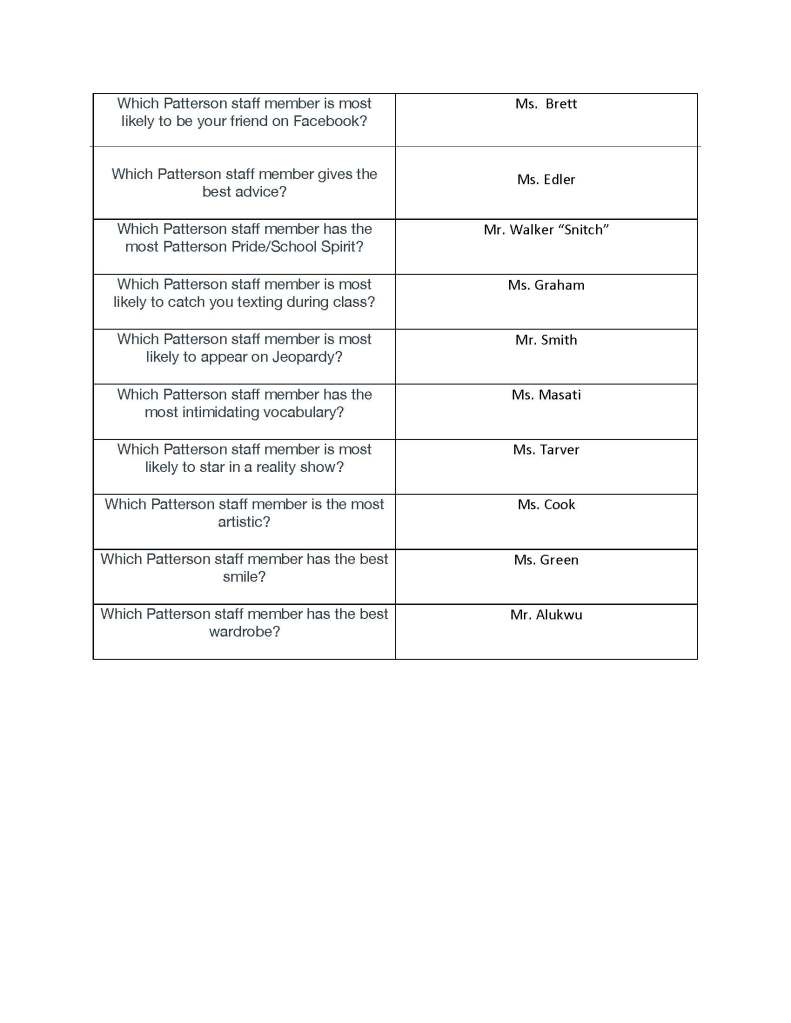
The Class of 2020 has had a tough year but they have come through and are excited to graduate and make their mark on the world! Here are the 2020 Patterson High School Senior Superlatives and Teacher Superlatives. Thanks to Ms. Edler, Kirone Anderson, and the rest of the senior class officers for putting together this list. Congratulations to the Class of 2020!
Note: There may be some spelling errors which will be corrected eventually but since the citywide graduation ceremony is on June 9th and the Patterson commencement is June 12th, we want to present the winners immediately so as many students and staff members as possible can see them before graduation. The Patterson Press did not create this list.
The coronavirus that is known as COVID-19 is affecting teenagers in different ways, both emotional and physical. Coronavirus is also affecting families and those students that need special classes. Schools perform a lot of functions that go far beyond education. Schools provide a safe haven for students but also a social setting and for families with students with special needs, offering educational support.
Online learning in comparison is not the same as learning in a school.
“Online classes are different from regular school in that you are not physically present with other individuals apart from the class”, explains Mr. Benton, the principal of Patterson High School.
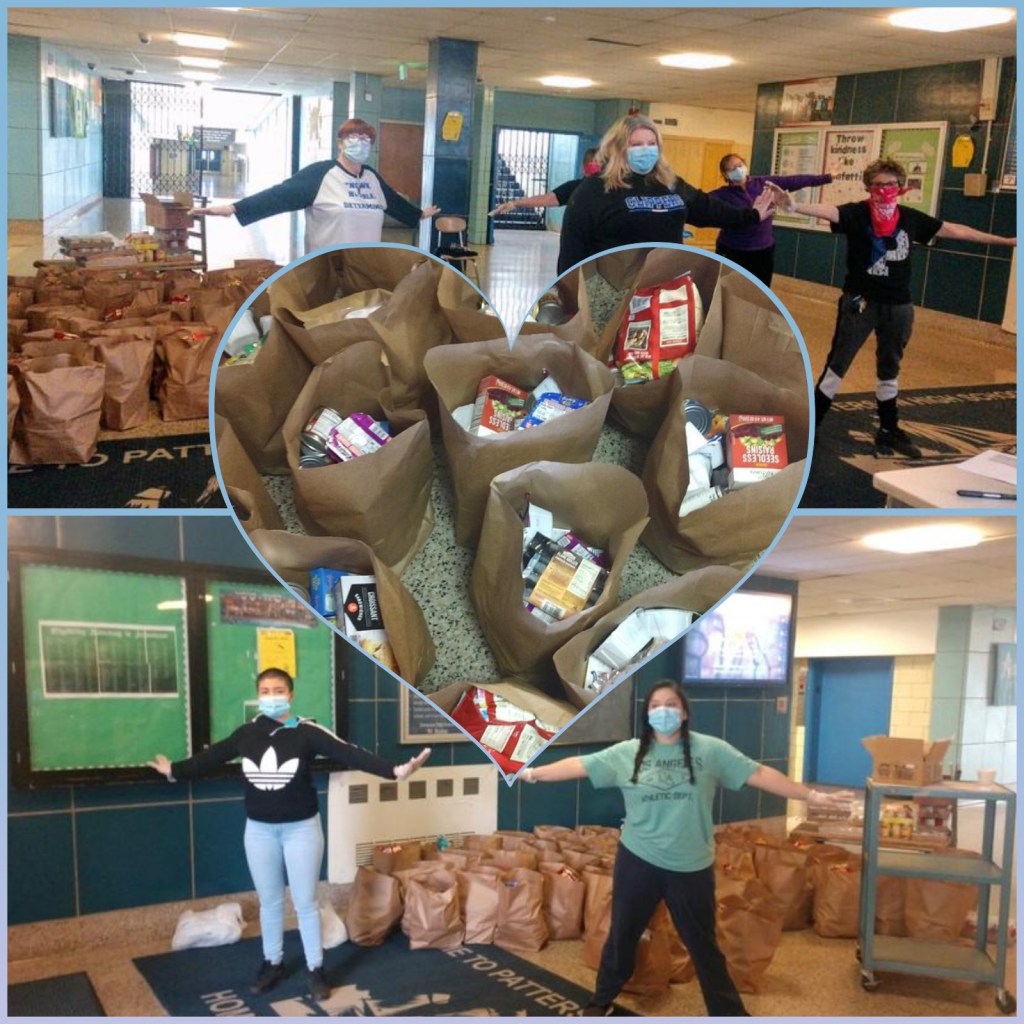
“Patterson is doing all that a school could or should do at this time. We are providing students a continuation of their education and have provided food and technology support to approximately 200 families”.
Patterson staff and students handed out food donations to hundreds of families. (Photo: Patterson High School)
During this quarantine, I feel stressed out and sad because I miss my regular life when I used to help others like my classmates. I miss my friends and being outside breathing fresh air. This pandemic has made me see that in these moments we have to be together as families but also as society and help one another because we can make this pandemic end if we stay at home and take the precautions that have been indicated. This is a great time to take stock of the things that we are doing to separate our families. My life will never be the same after this pandemic because I will take advantage of every moment in my life like that one will be the last one and take every opportunity that comes to my life.
Some other Patterson students also shared their feelings about the quarantine.
Ester Mumbala said, “This situation is making me feel sad, lonely and stressed out. I miss having a lot of fun with my friends like playing around every time. This experience has changed me by staying in one place and being alone. I think next school year will be very different.”
However, not all students are upset about the quarantine. Alexandra Artiga actually enjoys spending more time at home.
“This may be insensitive but I feel great. I finally get to stay home and spend all day with my animals and I always wanted online school classes. Now I don’t have a reason to go outside”.
At the same time, Alexandra is worried for other people who may be at risk. “What makes me upset is the people who still persist to go outside and put my mother’s life in danger when she goes to work and that terrifies me because she can get sick and I can even lose her forever.”
Some students said that they are feeling isolated during this time.
“During this pandemic I feel isolated because everything is closed so there is nothing to do and I’m not able to go places”, said Shawn Greene. “This pandemic has made me see that this world could come to an end because I never thought this was ever going to happen and this is separating families.”
Ms. Randolph-Seward is a staff member at Patterson High School who helps students with their social and emotional well-being. “I think that social isolation not only affects the mental health of teenagers, but it affects the mental health of all people”, Ms. Randolph explained. “This social isolation is not by choice, but by circumstances and government decisions. This social isolation creates feelings of loss, loneliness, depression, and the inability to control what was once simple/accessible, which allowed us to pick the WHO, WHAT, WHEN, WHERE, and HOW for our lives”.
Mr. Benton has some advice for how students can deal with negative emotions they might be feeling:
“Students can practice the things they’ve been hearing during our Mindful Moment time. Now is the time to use what has been provided- for times like these!”
When asked if he thought that things will ever return to the way it was before, Mr. Benton responded: “Things will never be the same after this pandemic because things aren’t meant to be the same. Change is the only constant, so it should be embraced.”
We are all doing our best to get through this crisis. Let’s stay safe and support one another so we can look forward to seeing each other again when the pandemic is over.
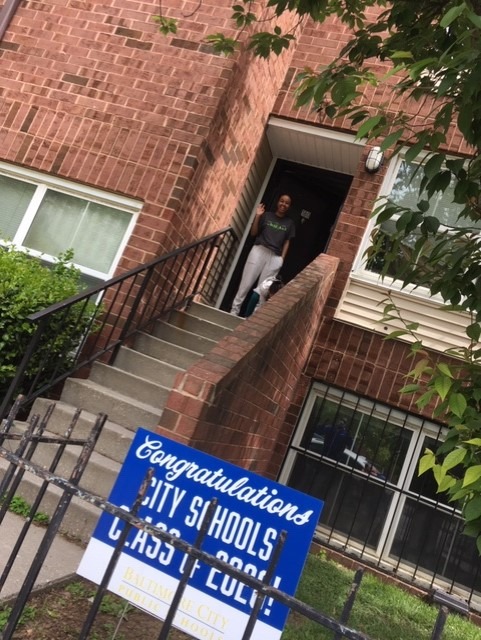
Patterson staff members surprised graduating seniors by personally delivering congratulatory signs to their homes. (Photo: Patterson High School)
For generations now, people have lost interest in bettering their lives through education. It has been an issue faced by teens and has risen higher and higher throughout the years. Dropping out of school should never be an option if all school does is bring good things to a person and helps in gaining more knowledge of what is out in the world. We should all be trying to figure out why students feel the need to drop out and how do we get them to stay.
In 2018, the dropout rate for African Americans in the United States was at 16.2%, whereas the dropout rate for 2017 in Baltimore, Maryland was at 17%. One reason why kids turn to dropping out is because of family problems, whether it’s money or something worse. It could also just be that they simply lost interest in the educational system thinking that it wouldn’t be able to help them.
I want to educate people on why students feel the need to drop out of school before fully accessing all the knowledge they can in high school. But not only to tell them why kids drop out but also to help others find ways to get the students to want to stay and gain this important experience/knowledge they will need in their futures. I don’t want people to keep pushing away this problem but instead learn and change. Kids need to know that there are people looking out for them. Encourage students to join various after-school extracurricular activities. Some examples of extracurricular activities kids could join include school sports teams, club sports, community volunteering, and so much more. Not only school extracurricular activities but also ones provided by the community.
Schools should have a job fair for students that need work to help support their families where they get introduced to different local jobs and learn how to write a resume. All kids should want to get an education, they should never lose interest in gaining knowledge.
Parents/guardians should check in with their child’s teachers to make sure they are engaged, but also check in with your child to make sure the teacher is giving proper information. Parents/guardians should also check on a school’s environment to make sure their child is well taken care of.
We rely on future generations to help the world become a better, safer place but that can’t happen without the knowledge of how to do so. No one seems to be discussing this very important topic and that need to change. We need to educate people on this issue before it is too late to fix. Pick the path that is better for you and for the people around you.
Naomi Hodge is a student at McDaniel College and a graduate of Baltimore City Public Schools.
Have you ever felt stressed and you couldn’t talk to anyone about it? You are not alone. Everyone at some point in their life will be stressed about something and/or someone.
Students in high school can feel many sources of stress. From school work to relationship issues it can put a hold on anyone. Sure, we don’t have to pay bills or have a full time job, but students can deal with a lot too.
According to the website TeenHelp.com, five main things that can cause stress to a teenager are school work, parents, friends’ problems, romantic relationships, and drugs in the neighborhood.
A ninth grader here, Anallely Santos Velazquez, said, “I feel okay about school; it is just the work in most classes that stresses me out.”
Also, Angelina Anderson, another ninth grader, remarked, ” School isn’t that bad; I just don’t like waking up in the morning. But what stresses me out is not getting work, assessments, done on time or just not getting work done.”
There are many problems that come along with stress. Many symptoms can take a toll on your mental health and body, including upset stomach, chest pain, fatigue, headaches, etc. Also, you can develop anxiety and depression, restlessness and the feeling of being overwhelmed. (Source: MayoClinic.org).
Patterson has many many counselors, social workers or psychologists that you can come to so you can talk to them. Whether you’re feeling stressed or need anything else, you can come to them. One of the psychologist that is in Patterson is Ms. Gaither. She gave us some advice on how to deal with stress or what causes it in the first place.
“Well, to know what causes stress you have to know what it is. It is like anxiety; an alarm system. That is what anxiety is usually is. Many things can cause stress. Typically school, since we are in school, but there can be other factors like family stress or it could be biologically because everyone is different so stress might be different.”
So, many things can cause stress, but you can also be stressed on things that are home related, taking care of siblings, parents, chores, etc. Also, some students have jobs, so now they have more worries on their plate. But Ms. Gaither also gave us some advice on how to deal with stress.
“You can face your fears. For example if someone doesn’t like science, they will try to avoid it, but you’re going have to go to science at some point. So if you face your fear, it can be a stress reliever. You can go to coach class, ask for help or anything at all. It is about overcoming those barriers. You can talk to someone, like myself, teachers or other social workers. Talk to someone you trust. You can exercise, working on your mind and physical health.”
Patterson High School has a program called Grant A Wish, where teachers sell merchandise and hold social events to make money to buy some things they need for their classes.
“I started the group because I was already running some grants for different things I needed and some one told me to start a group”, explained Mrs. Kelly Hope, one of the founders of the program.
Teachers who are involved in the program include Ms. Brett, Mrs. Hope, Mr. Frederick, Mrs. Stiles, Ms. Williams, Ms. Avellaneda, Mrs. Blankenfeld, and Ms. Mahoney. All of these teachers are glad that Mrs. Hope started the program, because every year the budget gets smaller and smaller and Mr. Benton has to make the hardest choices around February when it is budget time; for example: either to hire a science teacher or pay for something else.
Mrs. Hope described the process to apply for Grant A Wish money. “Teachers would fill out a form which has basic questions like how much money you need and how will it benefit your students. Then they will give the form to me or one of the other teachers in the program. Then we have a meeting on whether we should give them the money or not.”
If you would like to join the Grant A Wish committee, you would have to be 22 or older, but if you are not old enough to join, you can tell your parents or other people you know who are 22 and up. What younger people can do is buy tickets, promote or donate to help out with the program.
The Patterson High School engineering department received a sum of $15,000 in support from Amazon on Friday, Nov. 30, 2018.
The students of the engineering pathway, Amazon staff, and a representative from the mayor’s office all gathered in Ms. Ball’s classroom to meet each other.
A representative from Amazon give a brief presentation on some of the things they do each and every day. He also talked about some of the opportunities and benefits Amazon has given him as well as some of the fun times he had working for them.
According to John Digzon, a member of the robotics club who participated in the Amazon event, “I am really relieved because with Amazon support we can buy more resources we need for projects”.
After the presentation, the group left Ms. Ball’s room and went to the robotics room where students presented the robots they have been working on. They also demonstrated some of the things their robots can do at the Vex robotics competition practice stage.
Several students at Patterson High School were inducted into the National Honors Society on Dec. 7, 2018. Students brought their parents to watch them and celebrate.
The school had tried to start the program in the past but it was unsuccessful. This school year some students were able to achieve this very difficult feat.
According to Ms. Ericka Edwards, an English teacher at Patterson High and one of the co-advisers of the program, said, “It was long awaited and students deserve that honor.”
The students in the program were chosen based on their academic achievement. According to Ms. Edwards, “GPA, service to school and involvement in activity” are all criteria of being part of the society.
Anta Ndiaye, a student in the National Honors Society, said, “I feel honored and proud of being a member of the National Honor Society.”
Principal Vance Benton and Student Government President John Dingzon each gave a speech to thank the parents and the students and told them to keep up their hard work. Other dignitaries and special guests were also present to honor the students, including City Councilman Zeke Cohen.
The ceremony lasted for half an hour and refreshments were served at the end.
Building STEPS is a program that prepares students in Baltimore for college and careers with a focus on science and technology. I want to say thanks to everyone in Building STEPS and everyone that’s involved with the program. My journey through Building STEPS has been an experience of a lifetime, from climbing trees at Genesee Valley all the way to learning science, technology, and engineering and mathematics skills.
When I got the acceptance letter into Building STEPS at the end of my tenth grade year, I was so excited. I was excited because I knew I was going to get the help I needed to get into college. Believe it or not, before Building STEPS, I was shy and would not approach people for help and would not talk to people unless spoken to. They made my confidence level go from zero to a hundred. Building STEPS has helped me overcome a lot of challenges. The main challenge I overcame was being put outside of my comfort zone. I learned how to talk to people I didn’t know, and learned how to appreciate working in groups instead of on my own.
Building STEPS has also helped me with the college process. Without them, I probably would have pulled my hair out while I wrote my college applications. They helped me write my college essays, which I didn’t think were good until my Building STEPS writing advisor helped me. I am extremely proud that I got accepted to more than one college. I would not have been able to do that without Building STEPS. Building STEPS has helped me get into colleges I would have never dreamed about being accepted to.
In the fall, I plan to attend Mount Saint Mary’s University. I am going to play college baseball and to study criminal justice so when I graduate college I can be in the FBI.
Building STEPS has taught me a valuable lesson in life, which is to never be afraid to leave your comfort zone and don’t be scared to ask for help if needed. Thanks to Building STEPS, I have made friendships with people that I know will last a lifetime.



 pattersonpress.org