
Category Archives: Education News
The truth about the school budget for PHS

Amadou Bah, Sartre Ndebaneza, and Faran Nadeem went to North Ave to meet up with BCPSS Chief Financial Officer John Walker (second from left). (Photo: Yamen Khalil)
By Amadou Bah, Faran Nadeem, Justice Rice & Sartre Ndebaneza
If you visit Patterson High School, you are most likely to experience the change of climate when you are inside of classrooms. Besides the lack of air conditioning and adequate heating in the building, Patterson still uses computers with Windows 7 and some those computers are out of use. If you enter the computer labs, the first thing you see is keyboards with missing keys detached from their CPU. When the weather changes, everyone feels it. With all these problems that go unfixed, many students are asking, “Where does the school’s money go?”
We went to North Ave. to talk to John Walker, the Chief Financial Officer of Baltimore City Public Schools, about Patterson High School’s budget and what is the money based on. He gave us a book and explained how enrollment, funding, etc. works. We had a better understanding of what he meant about how all schools have the same progress with money being funded based off of student enrollment.
The Patterson Press reporters Amadou Bah and Sartre Ndebaneza interviewed Patterson’s business manager, Mr. Dwayne Adams, about how much money Patterson High School gets and what the school spends it on. Patterson High School’s budget for the 2016-2017 school year is 8.2 million dollars. The 8.2 millions dollars is based on Patterson High School student enrollment for 2016-2017. The state of Maryland is dealing with its own $544 million budget gap, and both state and city officials suggested that the school district will have to make tough decisions. According to The Baltimore Sun, the city lost roughly $42 million in state-given money this year, in part due to its worsening enrollment. Enrollment stands at about 82,000 students. Next school year, PHS will receive less money due to the $130 million budget gap. The school also receives donations and grants. According to Mr. Adams, 75% of all budgetary resources Patterson High School receives goes to teachers and other staff members. This includes salaries of substitute teachers. When The Patterson Press questioned Adams on where the other 25% of the money went, he replied, “It’s not a particular department that consumes the majority of the main funding. It’s called OTPS, so you have the salaries, and then you have OTPS, which stands for other than personal salaries, so that remaining–and this is just an estimate–25% of the budget is done by comprehensive review on what was spent.” Adams added, “We have some standing contracts that we know we have to carry every year, so we set a priority on spending. So the contracts we renew every year are included in the spending, and then we have to have a majority of it go to supplies and materials because teachers need these things for instruction purposes. We also have audio visual and computer related, so we can have technology within the building to keep us in the twenty-first century. Everything is more and more technical than the traditional sit-down-with-a-book type of instruction. Those three areas are safe where the money is spent.”

BCPSS Chief Financial Officer John Walker (Photo: Patterson Press)
We wanted to get a better understanding of Adams’ explanation about the 25 percent of the school budget that remains after paying staff members’ salaries (the part of the budget known as OTPS), which is roughly 2 million dollars each year. After doing some research and interviewing several staff members, we have found that the most expensive materials the school has that are expected to be purchased from school budget are computers. According to Ms. ClaireAgnes Doerrman, the school librarian, there are more than one thousand computers in the whole building. Ms. Doerrman also told The Patterson Press, “Since I came here two years ago, I saw only three brand new carts of computers.” All the carts combined had 90 computers. This statement calls into doubt Adam’s statement of Patterson annually spending a large percent of its budget on new computer technology.
The Patterson Press also interviewed Mr. Vance Benton, Principal of Patterson High School. According to Mr. Benton, “Since I was here, for six years, we only bought five to six laptop carts.” We also spoke to another trusted staff member who asked not to be identified. According to our source, “All the computers in the building are old. Most of them were donated, most of them are used computers from another school, totaling around 800 computers.” This staff member insists that this is not standard practice in Baltimore City. “Other schools receive, or if not buy, new computers every year to keep up to date, due to technology being upgraded and improved,” our source informed us. This proves that Patterson High School doesn’t really spend much money on the computers, but this kept us wondering what is the money is really being spent on.
We also wondered about other sources of money outside the official school budget. So we confronted Mr. Benton with some follow-up questions about where does the money from the vending machine, student IDs, and the school store goes. Mr. Benton stated that all vending machine money goes to the company that owns the vending machine; he’s not in charge of that money. As for the ID money, most of it goes toward field trip buses and to ink and other small supplies that are needed to make the student IDs. School store money goes back to the school store. It’s a cycle: money from the budget is used to boost the school store, but sometimes the school store’s money helps out with small expenses, such as paying for field trip buses.
In conclusion, we don’t get enough money, but instead the CTE and ESOL departments have their own way of getting money by applying for grants, donations, etc. Mr. Benton is pretty smart for not spending money on new computers due to the plans to construct a new school building next year. He stated that he is saving money because this school will be rebuilt and the new school will have new computers that are up-to-date.

(2016-2017 School Budget Book)

42 students, decrease (2016-2017 School Budget Book)
Patterson’s SGA represents at citywide student government meeting
By Mikal McCoy,
Patterson’s Student Government Association (SGA) attended a city-wide SGA meeting at Vivien T. Thomas Medical Academy on Thursday, November 17th, 2016 at 3:30 PM.
The meeting was for all City Schools SGA bodies, to inform members about what is going on in the State and National SGA boards. Patterson’s SGA members John Dingzon (Secretary), Amadou Bah (Vice President), and Mikal McCoy (President), attended the meeting to represent Patterson’s SGA and to learn more about Student Government Association’s program. Other schools such as Digital Harbor High School, Carver High School and Booker T. Washington Middle School attended the meeting. During the meeting , speakers such as Kevin Davis, Commissioner of Baltimore City’s Police Department, spoke to students about what’s going on in the communities of Baltimore City.

Patterson SGA officers Amadou Bah (left) and John Dingzon (middle) pose with BCPD Commissioner Kevin Davis and an unidentified woman (Photo: Patterson Press)
Police Commissioner Davis spoke to students about being safe, steps they can take to improve their communities and how many districts are in the City of Baltimore. “I learned that there are at least 10 districts in Baltimore and community meetings that mostly people older than 55 attend”,said Amadou Bah. During the meeting, one of the focal points Commissioner Davis stressed was that young people don’t attend community meetings that are held to talk about the problems in the community. “These meetings are a chance for you to give your voice and opinion”, said Davis. Commissioner Davis also told the group that if they attended a community meeting before the end of the year, he personally would take them on a tour of Baltimore City Police Department Headquarters.
Attending community meetings is important. A community meeting is an opportunity where young and older people can come together to talk, and figure out solutions to the problems in their communities. Overall, the citywide SGA meeting was very informative and Patterson’s SGA officers came back with fresh ideas about how to increase their involvement in the community.
Psychology with Mr. Baron

Photo: Physicsworld.com
By Jessica Branch,
Psychology is the scientific study of the human mind and its functions, especially those affecting behavior in a given context. A Psychology class is being taught here at Patterson High School by Mr. Baron in room 216. Throughout the course, students learn the basic fundamentals of Psychology while digging deeper into the brain.
One of the most popular projects Mr. Baron has done with the class is called the ESP Project. ESP stands for Extrasensory Perception. ESP or Esper, also called sixth sense, includes reception of information not gained through the recognized physical senses but sensed with the mind. The project was a test to show students that some people may have the talent to read other people’s minds and to tell them things about themselves that they couldn’t have possibly known. It was also a well-liked project in the class because it was out of the ordinary.
Does Patterson have what it takes to become a “Top 500” school?

Will Patterson High School become one of the top 500 high schools in the U.S.? (Photo: Mikal McCoy, Patterson Press)
By Sartre Ndebaneza,
For more than 5 years, Patterson High School has had a goal of being ranked in the top 500 best high schools in the country, as rated by the magazine U.S. News and World Report.
Some seniors at Patterson don’t believe in this academic goal that Mr. Benton and the school staff have set. They refer to Patterson’s reputation and performance, and compare them to the schools that are on the list of Best High Schools in the country for 2016. According to these students, Patterson’s goals are unrealistic.
“We gonna die of old age before that happens,” one senior at Patterson said of the goal. Discipline problems, low attendance, and poor academic performance on state and national assessments are still issues at Patterson. Patterson High School was unranked in the 2016 national ratings.

Mr. Benton insists that Patterson has the potential to be one of the top 500 high schools in the country. (Photo: Faran Nadeem, Patterson Press)
However, regardless of these challenges, Mr. Benton, principal at Patterson High, who has served the school for almost 6 years, believes that Patterson has improved already. He stated that “we are no longer identified as a turnaround school,” which is a big step for Patterson High School.
Mr. Benton is optimistic about the future of the school, but many students’ views are antithetical to the principal’s. Students see it as an impossible goal to achieve. The rank is based on student performance, but Patterson still needs to invest a lot of effort to improve school issues, including food fights in the cafeteria, security and student motivation. Students who attended Patterson for four years say hope for a better Patterson is an unbelievable thing.
“Things are getting worse every year. Students are misbehaving, racist, and don’t want to study,” Natasha Abrev Moran, a senior at Patterson High School, said.
In spite of the pessimism of many students, Mr. Benton is ready to challenge students and teachers in order to achieve Patterson’s goals. “We need teachers’ commitment and students collectively to improve academic success.” Mr. Benton said.
So what specifically does Patterson have to do to qualify as a “top 500” school? In order for any school to participate in the elimination process they must meet specific criteria established by U.S News and World report and North Carolina-based RTI International, a global nonprofit social science research firm. There is a four step process for determining which schools will be considered for the list:
- The school must be performing better than statistically expected for students in that state.
- The school’s disadvantaged students – black, Hispanic and low-income – must be outperforming disadvantaged students in the state.
- The school must meet or surpass a basic benchmark for its graduation rate.
- Schools that make it through the first three steps are judged on their college-readiness performance (based on Advanced Placement or International Baccalaureate test scores).
19 schools in Maryland made the top 500 list in 2016, although none of them were in Baltimore City.
As the saying goes, if your dream doesn’t scare you, know that it is not big enough. Patterson High School’s leaders have already crossed that limitation off their minds. They are determined to make Patterson a “Top 500” school, even if it may take many years to achieve. The journey is long to reach the goal, but Patterson is making changes for the better every day.
To read the 2016 “Best High Schools” report, visit http://www.usnews.com/education/best-high-schools .

U.S. News and World Report ranks the top 500 schools in the United States each year. (Photo: US News and World Report)
Students testify at MTA bus pass hearing

Students and parents lined up testify against recent changes to the MTA student bus pass (Photo: Brian Clark Jr., Patterson Press)
By Amadou Bah,
Students, teachers, parents and others attended a public hearing on Thursday, January 5th to testify to City Council about the need to extend the MTA student bus pass to 8:00 PM. The hearing took place at Frederick Douglass High School at 4:00 PM.
Until this school year, students were using S-PASS, which allowed users to ride the MTA bus for free between from the hours of 5 a.m. and 8 p.m. The S-PASS allowed for multiple rides throughout the day, making it possible for students to go from home, to school, to after-school activities and back home again.
However, with the new “One Pass”, this has changed. The current contract between the school district and the MTA limits the hours students not taking part in school-sanctioned activities can ride the bus for free, cutting it from 8 p.m. to 6 p.m. In reality, this is also impacting many student athletes as well as students who participate in after-school clubs like Coding Club, the Patterson Press, Chess Club and many others.
Many critics of the new MTA policy believe that the changes are being implemented in order to save MTA money. However, Sean Adgerson, deputy chief operating officer at MTA, denies this. In an interview with ABC2 News, Adgerson asserted that “any suggestion that the MTA has changed its S-PASS policy to save money at the expense of Baltimore City’s school children is simply inaccurate”. Adgerson told ABC2 News that MTA has created a process for the school system to provide bus fare for after-school programs.
Despite these assurances, students participating in non-athletic after-school clubs at Patterson are still not being provided with any additional bus fare and often have to leave their activities early to ensure that they get on the bus before 6:00. With a dismissal time of 3:35 PM, after-school programs at Patterson often do not start until 4:00 or later. Also, many Patterson students live far from the school and have to transfer busses multiple times. This makes it necessary for some students to board a bus after 6:00 PM if they stay for an after-school activity.
Additionally there is the issue of students who work after school or participate in other activities outside of school, such as volunteering, buying groceries for their families or spending time at a community center or a place of worship. MTA officials insist that this is not their concern. “Our contract was always designed to take kids to and from school and school related activities, not for jobs, not for those other things,” Adgerson said to ABC2 News.
Students and teachers stated their opinions about the bus pass issue at the City Council hearing and elsewhere.
“It’s really a shame that students are not able to ride the bus for free between the hours of 6 am and 8 pm as they were in the past”, said O’Brien Bobbi, an English 1 teacher. “I also think that there are a lot of problems with how the new S-Pass policy was rolled out to the schools because the first we’ve heard about it–well, the first I’ve heard about it–was when students were struggling and didn’t know that the bus pass stopped working at 6pm. I hope this problem will be fixed soon”, she said.
Nathan Nieves, a sophomore from Patterson High School, talked about having to leave Casa de Maryland’s Mi Espacio program early every day. “I’m trying to do my part by seeking out the positive, by learning how to help my community. I hope Baltimore City does their part too, to make sure I get home safe”, he said.
A Patterson student named John Dingzon commented on this issue, stating, “It’s really unfair for students that have after-school activities and don’t have enough time, due to this issue. Students that leave after-school activities wait at the bus stop and sometimes buses are running late.” Dingzon added, “When students get on the bus they’re expected to pay a fee of $1.70 which most kids don’t have and some bus drivers are rude and will not allow them on, due to this issue. All I want is that the new Bus pass be extended back to 8 or 9 pm.”
Dingzon had more to say but the City Council didn’t have enough time to hear him testify. A long line of students and parents who were still waiting to testify were turned away without getting an opportunity to speak. At 5:45 a member of City Council said, “Students need to be dismissed right now. City Council and MTA will try to find the best way to pass this bill”. Some members of City Council have pledged to fight until a new bill is passed and the bus pass for students is extended.
The hearing closed promptly at 5:50 p.m. so students could get that 6 p.m. swipe for the bus home, an irony that was not lost on the students and others who had come to the meeting to testify.
It remains to be seen whether City Council will figure out a way to get this issue resolved.
Patterson and NAF Students Help Create Prosthetic Hands For Those In Need

Engineering students share the limelight with their teachers, Mr. Yates (left) and Ms. Ball (right) (Photo: Northrop Grumman)By: Amadou Bah
By Amadou Bah,
Students from two Baltimore high schools (Patterson & National Academy Foundation) had the chance to create prosthetic hands for children around the world. Both Mr. Yates and Ms. Ball selected six students to go on the field trip on Oct. 3, 2016.
Students from Patterson High School and National Academy Foundation (NAF), had the chance to pair up with volunteers from Northrop Grumman for a hands-on experience. The students had the guidance of one volunteer from Northrop Grumman for each table, with the exception of Amadou Bah, who had the guidance of two volunteers. All students also had the materials from 3D printers as part of a program that organizers said “keeps rapidly growing every year.”
Those involved in the program hope developing a prosthetic hand will not only change the life of the child that will use it, but also the ones that are assembling it.

Prosthetic Hand Assembled by Students (Photo: Northrop Grumman)
The program is part of Manufacturing Week. Overall, 13 Northrop Grumman campuses across the country are doing the same project with students.
“Last year we did this event and we just loved it,” Ingrid Vaughn, vice president of manufacturing for Northrup Grumman, told WBALTV. “We were able to produce 160 hands, and we distributed them to Enabling the Future. So that was really a first-year big hit, so we are trying to do the same thing this year.”
When students are finished, the hands will go to a child in need anywhere in the world, thanks to the nonprofit, e-NABLE.
Journalism Students Attend Conference At University of Maryland College Park

Some of students who attended the J-Day event at University of Maryland College Park,(Photo: Patterson Press)
By Sartre Ndebaneza,
High schoolers who plan to pursue a career in journalism, and students who love to shoot photographs, attended a special event called J-Day (Journalism Day). During this annual event held at University of Maryland College Park, many high school students took advantage of the opportunity to learn important skills that make their photojournalism work valuable.
Professor Tony Richards, in what he called, “Quality Photography,” explained there are some keys to be a successful photographer. During the first thirty minutes of the lecture, Professor Richards shared with the audience the techniques of shooting a good photo, but he emphasized making a plan before you start working on your sample. He stated, “Planning things ahead of time gives you a better photo.” He advised young journalists, and photographers to plan things ahead of time in order to get good results.
Sarah, a 10th grade student at Patterson High School, testified that the J-Day was an interesting event. Smiling, Sarah said, “I went to the workshop about taking better pictures and I have learned new skills.” Sarah connected those new skills she gained from the J-Day event with her project of taking pictures. She learned the use of exposure and other tips in photography that will help her to do well when she will be taking pictures.
The J-Day was an interesting event for all high schoolers who attended.
Freedom of the Press Matters (OPINION)
By Justist Rice,
Freedom of the press is very important because it gives everybody a right to voice their opinions and express how people really feel. There have been more and more victims to police brutality every day. People’s families have been broken because of the deaths of family members at the hands of police abusing their authority. There are so many people who are hurt and angry. They all have stories to tell, and freedom of the press helps them tell their stories.
Government censorship affects journalism in a very bad way, because it blocks out and ignores very important facts, making it difficult to tell the whole story. Before Freedom of the Press, people weren’t allowed to voice their opinions, and if they did they were either arrested or bullied, and were stopped from writing–period.
There are limits to Freedom of the Press, such as libel, fabrication, and invasion of privacy. All these things are forbidden. People are not allowed to publish false statements to damage someone else’s reputation. It’s also forbidden to invade someone else’s privacy, meaning you can’t take a picture of someone if they are not in a public place. Similarly, you can’t hack into someone’s emails or messages and post them online.
In many states, reporters for school publications do not have the same rights as other news reporters. In many schools, student reporters are not allowed to talk about certain things, such as politics. The Maryland New Voices Act, which went into affect this October, allows student journalists to exercise freedom of speech without prior restraint. It gives student reporters a chance to express their opinions on any topic. Freedom of the Press is essential for people who want their voices to be heard, who are tired of being overlooked, who want to vent to the world.
Patterson continues tradition with 6th annual community fair

A stand from the community Fair (Photo: Patterson Press)
By Mikal McCoy,
Patterson High School had its 6th annual Back to School Night and Community Fair on the evening of September 22, 2016. Students, teachers and family members met together in the cafeteria to share a night of fun.
During the fair, there were games, activities and food. “It was a lot of food, a lot of chicken, vegetables and drinks”, said Yero Goloco, a student who attended the fair. For entertainment, different activities were planned. Students who were asked agreed that the fair was entertaining. “There was a lady belly dancing, people played drums, and there was a dance battle”, said Amadou Bah, another student who attended the fair. These responses reveal that people enjoyed the food and activities, but the Community Fair served other purposes as well.
Many families attended the fair. Students from Patterson High School invited their parents, friends, and relatives. Around 500 people attended the event. Dozens of community organizations, businesses and universities participated in the fair, along with many school groups and programs such as Robotics, Gardening, Coding Club and more. Each club had a stand with representatives who spoke with students and family members about what they do.
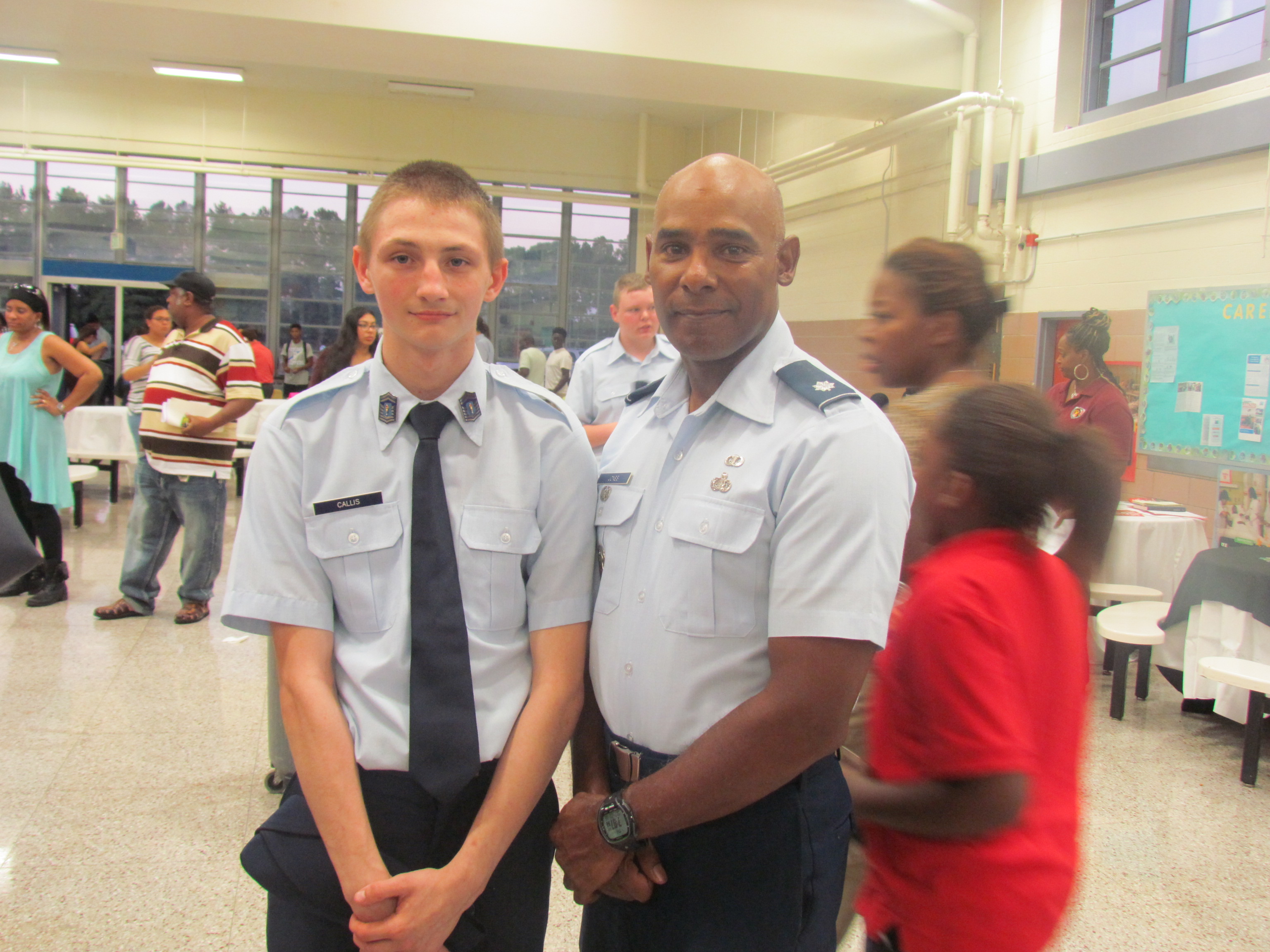
One group that attended the Community Fair was Patterson’s AFJROTC program. Cadets who attended the event helped out with setting up and seating visitors. “I was standing outside, greeting people, giving them their tickets for their sheets”, explained Abdullah, one of the cadets. Teachers, students and family members came together to make the Community Fair a success.
This year marked the 6th consecutive year that there has been a community fair event at Patterson. Ms. O’Brien and Mr. Alukwu started the event in 2011. “It was an idea that Mr. Alukwu and I came up with the summer before Mr. Benton became the principal”, recalled Ms. O’Brien. It takes planning, organization, and thought to come up with an idea like a school community fair and make it work. This year’s event was no exception.


 pattersonpress.org