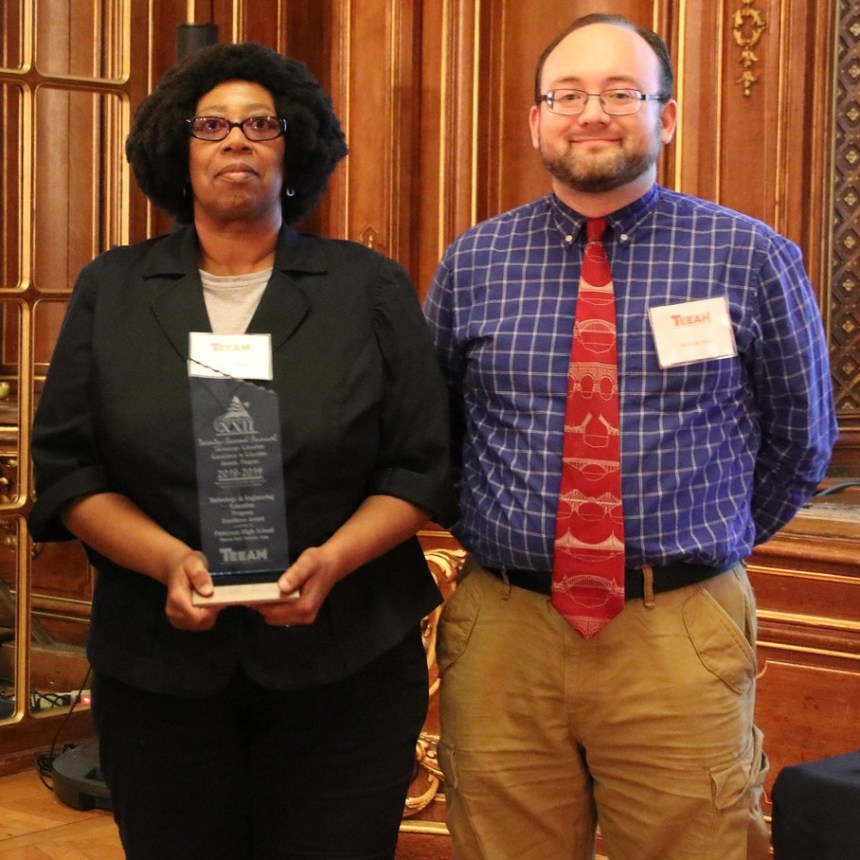
Patterson joins rally at City Council for banning styrofoam
By John Dingzon
By John Dingzon
By Lionell Green,
The Patterson band had been working hard all semester to perfect their songs, and they took their talents to City College High School on March 29, where they were in the yearly City Festival with several schools, including Carver and a couple of middle schools. It was not really a competition; it was more like a showcase of skills.
It was very entertaining to see the band do great in another setting. Multiple other schools praised Patterson’s band and the three judges were impressed. They played a total of three songs called “The Thunderer,” “Aftershock,” and “Chillaxin.”
Ms Williams was asked, “How did you feel about your band traveling to another school to play? She responded, “Traveling to City High School was an amazing opportunity for our students to showcase their musician skills that they acquired during the year. They got to experience listening to other bands and perform their best at the City Festival! As their teacher, I am proud, but as a musician I’m even prouder.”
Here are some of the comments from the judges:
“Very strong playing today!”
“Good job with a small ensemble!”
“Let me congratulate the bands from Carver, Reginald, and Patterson; I personally thought your students had great performances. Many times even the students get wrapped up in the sizes of the group or the ability of the players, but I thought your groups were confident, well-rehearsed, and committed to making you proud.”
By Amadou Bah,
Syncere Harris is an 11th grader, an honor roll student, and a track team member who has been doing indoor and outdoor track for 1-2 years at Patterson High School.
He started doing track in middle school but stopped because his heart wasn’t in it. When he got to Patterson, he was more involved in his 10th grade year and became interested in track again. What motivated him to start doing track again is his love for running. When he was little, he ran a lot for fun. Eventually, he started running every day.
The track events Harris participates in include the 100 meter, 200 meter, 4 x 200 meter relay, and the 4 x 100 meter relay. Track is one of his favorite sports and he is thinking about doing this in his future and for college. He always come in 1st or 2nd place. Recently he won 1st place at Mervo in the 100 and 200 meter races.
Harris excels off the track field too. He is currently taking a digital electronics class with Ms. Ball. “He’s always busy because Coach Smith comes and gets him for a track meeting for two minutes but he comes back in 30 minutes,” said Ms. Ball. He does get his work done though, and he is passing her class with an “A”. He is an active learner. He answers all the questions and goes up to the board to impress everyone with his skills.
Overall, Syncere Harris puts education first, then sports. He makes sure he is passing all of his classes. If he is failing or doesn’t understand what he’s doing, he stays after school for coach class. He is very intelligent and self-motivated, a great role model for other Patterson students to follow.
By John Dingzon,
On March 10, 2017, Lt. Colonel Jones and Technical Sergeant Smith took the Color Guard units to compete against other high schools in the Baltimore City district. It was a city wide Junior ROTC drill meet. There were sessions for unarmed and armed drill units, as well as unarmed drill sequence regulation, and unarmed drill inspection.
It has been nearly 10 years since the Patterson High School Air Force Junior ROTC competed against other high schools in a drill meet competition. The Color Guard team started practicing from the beginning of the school year. They practiced marching, and learning all of the techniques. The new students started learning the maneuvers, but the Color Guard did not practice hard enough until January 2017.
Lt. Colonel Jones started the selection of students who will be on the events and began the training for the actual competition. The real competition did not start until the month after the event. They all work hard to get prepared for the competition and even, the Color Guard took on new maneuvers and drill sequences. They worked hard and did a great job, all the way through the finish line.
The ROTC faced the challenged of finding the time, and created the Color Guard team as the extra-curricular or co-curricular activity and did not have consistent attendance, and that’s because many of the students are part of extra-curricular or co-curricular activities, including the varsity athletics. So they are pulled in different directions. So the biggest challenged this year for the ROTC is for them to come to practice. They had to also use some class time to be able to practice, but this was limited so it did not take away from the academics.
Lt. Col Jones goal was to able to find a time for practice after or before school, so they were not interrupted from their studies. The next event for Junior ROTC is next year again. So anyone who want to can able to participate and also be part of an annual event. It’s also part of Junior ROTC, and what they’re calling the CEO’S Cup, and the Chief Executive Officer for the district. It’s also basically like the Commander-In-Chief’s Trophy with the military academy. So the team who wins more events throughout the year will earn this trophy of ROTC in the units.
There were also individual awards. There’s what they call individual drill or Knockout. It’s basically like Simon says. They give commands and people are ask to dropped out if they do the commands incorrectly or if Simon doesn’t say the commands correctly. Patterson High School ROTC made a great showing, but Baltimore Polytechnic Institute (Poly) won the overall event.
It was a great, fun-filled event. In the city this event will happen again next year. Lt. Col Jones hopes the ROTC will participate more in other categories next year. “This year Baltimore Poly won 1st place in the Color Guard, but I think the other schools know we are the school to be watched for next year,” said Lt. Jones.
[PHOTO]

The current building, constructed in 1960, will be demolished after the new building is finished. (Photo: http://baltimore21stcenturyschools.org)
By Alvaro Flores & Amadou Bah,
In 2013, funding was approved to replace the whole Patterson High School building with a brand new one, but little progress has been made since that time. Patterson High School has a poor facility condition which means that the school is pretty run-down and is now getting worn out. The Patterson Press decided to investigate the reason for this delay and discover what the plan is for the new building.
Back in 2013 a bill was passed and the General Assembly agreed on a financing plan to allow Baltimore to spend roughly $1 billion dollars on school construction to repair or replace broken-down buildings over the next seven years. The plan is known as the 21st Century Buildings fund. The plan requires Baltimore, the city school system, and the state to put up $20 million a year each to help pay back this loan over the next 30 years. Patterson High School is among the schools scheduled to benefit from this money.
The Patterson High School building is currently 303,582 square feet. The original building was built in 1960 at 230,000 square feet. Additions were built in 1968 with 49,634 square feet and in 1977 with 23,948 square feet. In 1977, a 9,211 square feet renovation was completed. Science lab renovations of 10,800 square feet were completed in 1995 and locker room renovations of 9,225 square feet were completed in 2001. This means that in previous years, instead of building a new school building, they were adding more space to the school.
Not only are we going to get a new building in the near future, we are also going to be pairing up with a Special Education school called Claremont Middle/High School. Also, there are some really special features planned for the new school, such as three additional basketball courts, two additional tennis courts, bleachers for visiting teams, a press box and scoreboards for baseball and softball fields.
According to Jessica Clark, “In 2013 the Government Association approved for the construction of the new Patterson building to occur and will be complete in 2019.” This proves that the new Patterson building is guaranteed, but no updates have been made since that time. The Class of 2017 seniors were all wondering why they won’t see the new building before they leave. It’s coming, Seniors! You’ll just have to come back as alumni.
Patterson High School’s program contains several education programs which will impact the design of the building and the space requirements. These programs are: AOP program, Life Skills, Academy of Engineering / Project Lead the Way / Design Technology, Advertising and Graphic Design, Allied Health, Emergency Medical Technician / Homeland Security, Business Administration / Finance and Accounting, Cosmetic Services, Child Care, and ROTC.
The new building has been delayed for a number of reasons, including disagreements about how to spend the money that has been allocated for the new school (for example: we currently have a pool but a new pool will cost millions of dollars that could otherwise be spent on technology or other things). With that being said, the plan is finally moving forward. Construction on the new building will start this year. It is expected to be finished in the school year 2020-2021. This will be the 3rd Patterson High School building. This new school building will be the future.
Enrollment projection:
By Sartre Ndebaneza,

The San Diego Zoo contains animals from around the world, including this giant panda named Bai Yun. (Photo: Matthew Field)
We are all familiar with taking a short walk in a park, visiting zoos, and even taking some food to feed those poor animals. How about giving your loved ones a visit to a Sea World show? How about protecting animals and providing them with good healthcare and feeding them? There are a lot of significant reasons to consider in order to keep these animals behind bars. But what is the purpose if we do all these things for our own interest?
It has been said that we need to protect the environment, but we still hear some leaders say that climate change is hoax. Big corporations polluted the air but noone can point fingers at them. Government agencies and private organizations seem to care about nature but many people do not. So why do we really keep animals in captivity?
First, people started the open parks for wild animals. Then, so sea animals were not left behind, people took them from their world in order to keep them in pools. Is pool water better than ocean water? Were the jungles where those zoo animals used to live worse than those little shelters people enclosed them in?
If you are a true world-saver think about this: An African elephant covers about 80 kilometers (around 50 miles) a day. Is there any comparison that we can make with these elephants locked in zoos? It is better to take care of animals and love them but why do we deny them the right to live naturally?
For instance, at the San Diego Zoo, trainers trained animals, including dolphins, to do tricks. Trainers make animals do tricks by rewarding them with food. It sounds good but this is a technique to change animals’ psychology, and when animals act differently trainers call it rebelling or bad behavior. We know that when those animals lived in jungles or in oceans they ate when they were hungry, not when they did tricks. And they got food by hunting, not by being fed by people’s hands. What would you do if you found out someone was changing your lifestyle in a way you don’t like?
There may sometimes be good reasons to keep animals in captivity, such as helping endangered species to breed, but most of the time wild animals are better off in their natural environment, not locked up for our entertainment.

Photo: National Institutes of Health (public domain)
By Christian Pietrowski, Lionell Green and Jessica Branch,
Patterson is known for the roaches and mice that can be found all throughout the school. A lot of classrooms have mice living in the walls and sometimes during the day they make an appearance. So why does Patterson have this rodent and insect problem if the janitors clean every day–both after the students leave and during the day?
Ms.Rivera, head custodian at Patterson High, told the Patterson Press, ”I honestly have no clue why there is a rodent problem in Patterson because I work like crazy and so do the other custodians.”
Morgan McCafity, a senior at Patterson High, said, ”The rodent problem is sad and scary.” She doesn’t want rodents running across her feet when they could possibly have a disease.
Honestly, the rodent problem at Patterson is sad because Patterson is a really nice school and is actually cleaned on a regular basis. So if Patterson is cleaned regularly, why is there a rodent problem? To discover he answer to this question, we went around the school and asked questions to random students and teachers in school. Here are the questions we asked and a random sample of some of the answers we received:
As an experiment, two of us walked around the school to see how many mice and rodents we could each find in just 5 minutes (for a combined total of 10 minutes between the two reporters). Here is what we found, broken down minute by minute:
All in all, Patterson has a really bad rodent problem. Patterson might be one of the worst schools with a rodent problem. Part of the problem is because the school has small holes in the floors and walls and the animals are small so they can come in through the holes. The custodians clean as often as they can, but as long as students continue to throw trash everywhere the rodent problem will not get any better.

Students who participate in RYP program with National Geographic staffs in Washington DC. (Photo: Ms. Kursten Pickup)
by Sartre Ndebaneza,
Students who participate in the Refugee Youth Project program went on a field trip to Washington DC on March 17 . The trip featured a tour of the headquarters of the National Geographic Society where students learned how experts in different fields use photos to express their messages.
National Geographic’s employees who work in the studio showed RYP students how they take some incredible pictures to illustrate ideas in magazines or to break down myths. One experience students benefited from was an explanation of the meaning behind a broken glass that contains water. The information that the broken glass with water gives is to tell people that the concept of drinking eight glasses of water a day is wrong. There is not any scientific proof that drinking eight glasses of water a day is beneficial.
After that, students took a tour of a building where they went to see the archives. Because all RYP students are from different countries, everyone got a chance to observe some historic photos taken in their countries. Another thing students got the opportunity to visit was National Geographic museum.
This field trip was a great experience for all the students who participated in it.
By Sartre Ndebaneza and Amadou Bah,
Most Americans are questioning if President Trump’s executive order restricting immigration from seven predominantly Muslim countries is legal or illegal. The order appears to be illegal because it puts limits on a particular group of people. Trump’s order is unconstitutional because it targets only one religion. The editors of the Patterson Press believe that everyone should be welcomed and treated fairly in the U.S. regardless of their religion, ethnicity and national origin. The beauty of the U.S. is its diversity. Immigrants also contribute a lot to America’s economy. What is still not understandable is why Trump kept people from those seven Muslim countries from re-entering the country when they were legal residents who already had green cards and had not done anything wrong.