
Tag Archives: school

School fights continue to be a problem at Patterson

by Ashley Sarmiento Rodriguez

Why do students fight in school? I’m a senior at Patterson High School and over the last few years I’ve seen many students get into fights around me. Some of my fellow students have even lost their lives because of school-related problems.

My 9th grade year was the first year Patterson’s new building was open. There were always many students having problems and they would constantly be fighting around the school with seemingly no consequences. I always wondered why the teachers and staff never called the parents of Patterson students who started fights and at least let parents know what the school where their children go to had going on, especially when there would be multiple very large fights going on school.

In December and January 2024, I posed that question to some of the school’s hall monitors and Climate staff. Ms. Enjoulek Jackson (AKA “New York”) said “We aren’t allowed to just call home and tell the students’ parents that there have been fights at school because they need permission from school boards to call parents and then if that was to happen it leads to parents being worried and rushing to come take their kids out of school over a situation that they will always have under control; Unless it involves a more serious situation–then they do call students’ homes.

I walked around the school interviewing Patterson staff/hall monitors and also our school police–Officer Torbit and Officer Jones–questions about these fights.

A few hall monitors such as Mr. Rivas told me students fight mostly over drama on social media and also problems which are easy to resolve but which some students don’t really like to resolve in easy ways. 

When asked how many fights the Patterson hall monitors had seen in the past month, most estimated the number at around 15-20 fights while others said about 3-5 fights. Some hall monitors like Mr. Walker haven’t seen many fights while others have seen fights break out more often in certain areas of the school.
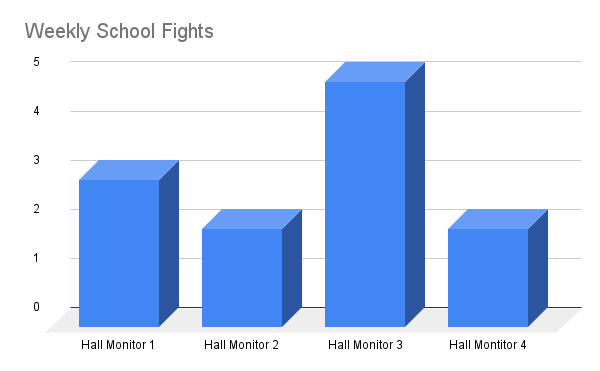
Average number of fights per week witnessed by hall monitors in December 2024 (Source: Interviews with hall monitors)

Officer Jones said when someone gets into a fight at Patterson, she and or her partner would go to the location of the fight and stop it and figure out what happened and make sure everyone’s OK. Then the student is brought to the administrators and they figure out who was in the wrong and the guilty parties get suspended for 3-10 days depending on the way things escalated. 

Although school fights remain a serious problem at Patterson, a lot of progress has been made over the past few years. Three years ago, fights and problems at school were really bad and there was an uncountable amount of fights and dangerous activities going on, but by the time I entered 11th and 12th grade, the fights had most definitely calmed down and the school climate has continued to be calmer than it used to be. Yet even now, every other day there is a fight going on in school. 

What do school staff members do to prevent these fights and problems happening during school? According to Mr. Will, “After a fight we break it up, figure out what happened, then have a mediation group and make sure both parties resolve and agree to not fight again during school hours.”

At the end of the day I think Patterson High School is now changing for the better and there are far fewer fights than there used to be. The school is actually trying to prevent them and has put things in place to help achieve that goal. Patterson High School has long had a problem with fights that students keep causing. Although my research shows that it has gotten better over the years, it’s still an ongoing problem. I am hoping many students read this and realize that this is a problem in our school and maybe help stop or prevent a fight. At the end of the day, there are many other ways to resolve a problem or conflict.
New school building’s lack of space impacts learning conditions

by Breon Thacker and Quaron Walker-Bey

Three years after the grand opening of the new Patterson High School building in 2021, students and teachers are struggling with a shortage of space, leading to a host of problems for the growing school population.

According to a 2015 report on the 21st Century Schools website, the old Patterson building took up 303,582 square feet. By contrast, the new building, which is shared with the Claremount School, was projected to be 267,771 feet total, including both schools. Teachers who remember the old building are glad to have the improvements in facilities and technology but are frustrated with the lack of space and the issues it creates.

“I like the new school building with the new technology, but at the old school building there was more room for students; teachers weren’t on top of each other”, reflects EMT instructor Mr. Casey. Mr. Casey thinks the 21st Century Building program could have planned the switch better. According to Mr. Casey, the building was originally designed for about 1,000 students and we are at or above about 1,300 now. The student population is overcrowded for the size of the building. Also, there is a bandwidth lag in the Wi-Fi system because so many students are on it at once. To compound the problem, there are not enough classrooms for the number of teachers in the building, forcing some teachers to share classrooms with other teachers whose curriculum or subjects are totally different from one another.

Some teachers have to move from classroom to classroom throughout the day, making it difficult to prepare for lessons. World History teacher Mr. O’Neal is one of these teachers. He says that some of the teachers here are very unsanitary, so he has to spend time cleaning up other after classes that aren’t his, and it can make it difficult to plan ahead of time for class. Mr. O’Neal has to switch classrooms every period that he teaches a class. Mr. O’Neal goes on to explain that he has 20-25 students per period and due to the small classroom sizes there is often not enough room for all his students to fit. Frequently kids may have to stand up for a whole class period.

Many staff members and and students share the opinion that the school should have been built larger, with more classrooms and offices and more space overall. Since the past can’t be changed, the question now is how to address this problem going forward. Should the school cap enrollment and try to lower the student population in future school years? Should school leaders seek funding for the building to be expanded? Should Claremount be relocated to a new site so that Patterson can utilize that section of the building? None of these potential solutions seem very viable in the present moment, but the problems caused by the lack of space at Patterson are becoming harder and harder to ignore. Something needs to be done about this issue or it will only get worse.

Breaking down school funding: Where does the money go?

by Wilfredo Portillo

Funding public education is a crucial responsibility shared across state, federal and local governments. But how exactly is this money distributed, and where does it go? Here’s a closer look at the intricacies of school funding and how it impacts teachers, students and programs.

Public schools receive their funding from three primary sources: state funding, federal funding and local government contribution. Each source plays a vital role in ensuring schools have the resources they need to function effectively.
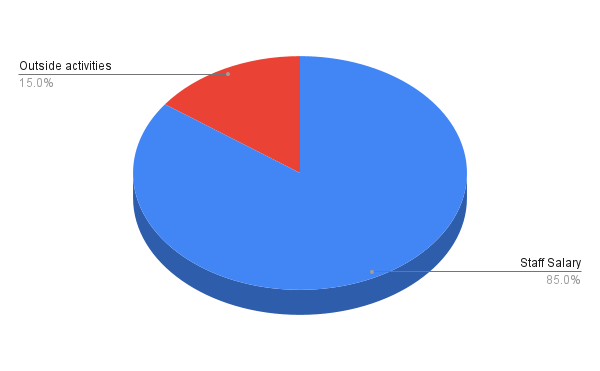
According to Patterson’s business manager, Mr. Cox, approximately 85% of school funding is allocated to paying the salaries of teachers and staff, along with health insurance and other related expenses. healthcare The remaining 15% is distributed across several categories. Some of it is spent on classroom materials and other necessities required to maintain daily operations, while the rest goes toward funding other priorities, including arts programs and extracurricular activities such as athletics, clubs, and field trips. These programs provide students with opportunities beyond academics, fostering personal growth and teamwork. The school district oversees the funding for school lunch programs, ensuring that students across different schools have access to meals.

Estimated Breakdown of 2024-2025 PHS School Budget (Source: Mr. Cox)


As schools prepare to receive additional funding later in the school year, there is a clear focus on addressing the pressing issues and improving student outcomes with key priorities being recruiting and retaining high quality diverse educators, supporting mental health initiatives for students, improving attendance rates, reducing dropouts, accelerating literacy and math achievements, and providing students with a well rounded education.

Based on the budget forum that was held in December 2024, there appear to be no major controversies surrounding the distribution of school funding. Most outside activities and extracurricular programs are funded equitably, with small percentages drawn from federal funding to support their cost. Additionally school districts and various agencies work collaboratively to manage and allocate these funds efficiently.

The distribution of school funding plays a pivotal role in shaping the quality of education and opportunities provided to students. While the majority of funds go towards staffing and essentials, efforts are being made to address evolving needs, such as mental health support and literacy improvement. With future priorities focused on equity, readiness and innovation, school funding remains a vital tool in preparing students for success.

Students prepare for new semester

By Kimberly Aguila-Torres

Patterson High School’s first two quarters are coming to an end already. Final exams are soon to start right when we students come back from Winter Break. Right now, teachers are wrapping up their final lesson for students before they head off for their Winter Break.

I asked several students if they were ready to start a new year with new classes.

”It’s whatever”, said one student. “I had gotten used to in my classes so it’s going to feel weird when we have our new classes.”

“It is gonna be a change for students.”, another student replied. “This is the first year that Patterson High School does this [semester schedule], but students will adapt to their new classes. Some will have the same lunch and some will change.”

I followed up my first question by asking these students if they like the classes they will be taking next semester.

One student responded, ”Nah, really I will be having geometry–and I am not great at math–and chemistry, which I think I properly will do not good.”

So far, there are students that like this new semester-based schedule and some that don’t and wished that they could just stay in the same classes throughout the whole school year. It’s going to be difficult for students once they come back from their break and have to take a lot of final exams for each class.

“I am feeling really sad because I wont be with the same people I was in class with.”, one student lamented when asked how they felt about the semester ending.

Hopefully students will enjoy their new classes and get used to their new schedules for next semester.