Category Archives: Public Safety

Investigating Patterson’s rodent problem

Photo: National Institutes of Health (public domain)

By Christian Pietrowski, Lionell Green and Jessica Branch,

Patterson is known for the roaches and mice that can be found all throughout the school. A lot of classrooms have mice living in the walls and sometimes during the day they make an appearance. So why does Patterson have this rodent and insect problem if the janitors clean every day–both after the students leave and during the day?

Ms.Rivera, head custodian at Patterson High, told the Patterson Press, ”I honestly have no clue why there is a rodent problem in Patterson because I work like crazy and so do the other custodians.”

Morgan McCafity, a senior at Patterson High, said, ”The rodent problem is sad and scary.” She doesn’t want rodents running across her feet when they could possibly have a disease.

Honestly, the rodent problem at Patterson is sad because Patterson is a really nice school and is actually cleaned on a regular basis. So if Patterson is cleaned regularly, why is there a rodent problem? To discover he answer to this question, we went around the school and asked questions to random students and teachers in school. Here are the questions we asked and a random sample of some of the answers we received:

  1. Why is Patterson so dirty? (Because students leave trash everywhere, not caring about trashcans.)
  2. Why are there so many rodents in Patterson? (They are smart creatures and they find their way in no matter what.)
  3. If the custodians clean, WHY is it so dirty? (Because students throw trash wherever they can and whenever they can even if there is a trashcan 5 feet away.)
  4. What makes Patterson so dirty? (The students.)
  5. Why haven’t we gotten an exterminator? (We have a couple times but it doesn’t work.)
  6. Where are they coming from? (The outside of the school.)
  7. Why haven’t we stopped this? (Patterson has tried numerous times.)
  8. What is causing the rodents to come out? (The cold and the trash and food crumbs that are on the ground.)
  9. How many rodents have you seen in a day? (About 8 or 10.)
  10. How can we stop them from coming in? (Block all the small holes and ways that they come in.)

As an experiment, two of us walked around the school to see how many mice and rodents we could each find in just 5 minutes (for a combined total of 10 minutes between the two reporters). Here is what we found, broken down minute by minute:

pietrowski- Lionell-Branch (1)

All in all, Patterson has a really bad rodent problem. Patterson might be one of the worst schools with a rodent problem. Part of the problem is because the school has small holes in the floors and walls and the animals are small so they can come in through the holes. The custodians clean as often as they can, but as long as students continue to throw trash everywhere the rodent problem will not get any better.

New student group brings different cultures together to solve school problems

By Natasha Abrev-Moran,

There is a new group in Patterson High School called SPIRIT.  This group started on October 16, 2016 with about 60 students involved.  The meaning of SPIRIT is Students Problem Idea Resolution of Issues Together.  The purpose of this group is to bring different cultures together to find out the concerns they all have and find resolutions.

The  sponsors of this group are CASA de Maryland and Jamya Ceisa de Maryland. In the group, students are the leaders who talk about their concerns. These concerns involved school safety. They advocated for more security and fixing the alarm detectors. This issue was brought up to the principal who took action by hiring new security staff and stating he would look into resolving the detector problem.

Another issue many students are concerned about is safety before and after school. “Most students fear for their safety while on the bus. Thanks to the SPIRIT group, they will be working on fixing that and pushing to have a positive outcome,” said Margot Harris, ESOL department head.

SPIRIT meetings occur once a month, usually after school or during lunches in room 315. If you have any concerns or wish to join feel free to speak with Ms. Harris.

CyberPatriot competition teaches students cyber-security skills

Image: Franklin County AFJROTC

Image: Franklin County AFJROTC

By Faran Nadeem & Amadou Bah,

CyberPatriot is a program in which students are given images (operating systems) that have some errors in it and we are supposed to secure them. As we secure the image we gain points each time and if we make it unsecured we will lose points.

This is an after-school program at Patterson High School although in many other schools they have a separate class about it. Our team name is the Cybernauts. The first competition of this school year took place on November 11th, 2016 and the competition was about 6 hours long, including the lunch break.

Two more competitions were held over the next two months. The competition is online and that is great so we can participate from our own school.


E.M.T. seniors visit Fire Academy

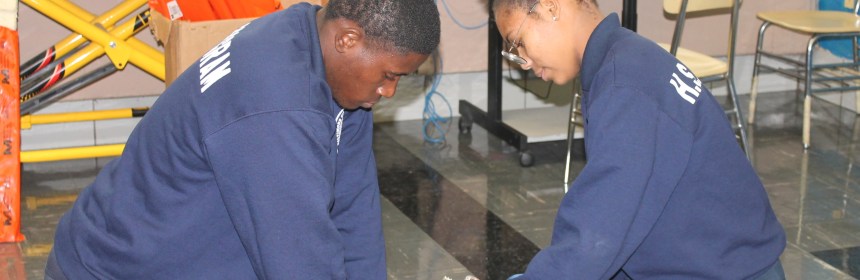
EMT students get hands-on experience (Photo: Patterson Press)

When they are not visiting the fire academy, EMT students practice their skills in the classroom (Photo: Patterson Press)

By Christian Pietrowski and Morgan Mccaffity,

Every Wednesday and Thursday, the seniors in the E.M.T. (Emergency Medical Technician) pathways at Patterson, Vivian Thomas,  Douglass and Dunbar go to the Fire Academy on Pulaski Highway to learn E.M.T and fire training. This program prepares students for a career as an E.M.T. or firefighter after high school.

Baltimore City has been wanting to do this program for years but the funding just wasn’t there. This is the first year the City has done this. Once, when students went to the Academy, they did hands-on learning, which was learning how to do suctioning.

The day before winter break, the E.M.T. students worked with kids from Armistead Elementary School as well as another school to show the younger students what goes on. The event helped to build community-based relationships. Lionell Green, a student in the program, said, “It helps me prepare for when I graduate to become a EMT and helps me get a good paying job.”

The City hopes this program goes on for years to come.

Students testify at MTA bus pass hearing

Students and parents lined up testify against recent changes to the MTA student bus pass (Photo: Brian Clark Jr., Patterson Press)

By Amadou Bah,

Students, teachers, parents and others attended a public hearing on Thursday, January 5th to testify to City Council about the need to extend the MTA student bus pass to 8:00 PM. The hearing took place at Frederick Douglass High School at 4:00 PM.

Until this school year, students were using S-PASS, which allowed users to ride the MTA bus for free between from the hours of 5 a.m. and 8 p.m. The S-PASS allowed for multiple rides throughout the day, making it possible for students to go from home, to school, to after-school activities and back home again.

However, with the new “One Pass”, this has changed. The current contract between the school district and the MTA limits the hours students not taking part in school-sanctioned activities can ride the bus for free, cutting it from 8 p.m. to 6 p.m. In reality, this is also impacting many student athletes as well as students who participate in after-school clubs like Coding Club, the Patterson Press, Chess Club and many others.

Many critics of the new MTA policy believe that the changes are being implemented in order to save MTA money. However, Sean Adgerson, deputy chief operating officer at MTA, denies this. In an interview with ABC2 News, Adgerson asserted that “any suggestion that the MTA has changed its S-PASS policy to save money at the expense of Baltimore City’s school children is simply inaccurate”. Adgerson told ABC2 News that MTA has created a process for the school system to provide bus fare for after-school programs.

Despite these assurances, students participating in non-athletic after-school clubs at Patterson are still not being provided with any additional bus fare and often have to leave their activities early to ensure that they get on the bus before 6:00. With a dismissal time of 3:35 PM, after-school programs at Patterson often do not start until 4:00 or later. Also, many Patterson students live far from the school and have to transfer busses multiple times. This makes it necessary for some students to board a bus after 6:00 PM if they stay for an after-school activity.

Additionally there is the issue of students who work after school or participate in other activities outside of school, such as volunteering, buying groceries for their families or spending time at a community center or a place of worship. MTA officials insist that this is not their concern. “Our contract was always designed to take kids to and from school and school related activities, not for jobs, not for those other things,” Adgerson said to ABC2 News.

Students and teachers stated their opinions about the bus pass issue at the City Council hearing and elsewhere.

“It’s really a shame that students are not able to ride the bus for free between the hours of 6 am and 8 pm as they were in the past”, said O’Brien Bobbi, an English 1 teacher. “I also think that there are a lot of problems with how the new S-Pass policy was rolled out to the schools because the first we’ve heard about it–well, the first I’ve heard about it–was when students were struggling and didn’t know that the bus pass stopped working at 6pm. I hope this problem will be fixed soon”, she said.

Nathan Nieves, a sophomore from Patterson High School, talked about having to leave Casa de Maryland’s Mi Espacio program early every day. “I’m trying to do my part by seeking out the positive, by learning how to help my community. I hope Baltimore City does their part too, to make sure I get home safe”, he said.

A Patterson student named John Dingzon commented on this issue, stating, “It’s really unfair for students that have after-school activities and don’t have enough time, due to this issue. Students that leave after-school activities wait at the bus stop and sometimes buses are running late.” Dingzon added, “When students get on the bus they’re expected to pay a fee of $1.70 which most kids don’t have and some bus drivers are rude and will not allow them on, due to this issue. All I want is that the new Bus pass be extended back to 8 or 9 pm.”

Dingzon had more to say but the City Council didn’t have enough time to hear him testify. A long line of students and parents who were still waiting to testify were turned away without getting an opportunity to speak. At 5:45 a member of City Council said, “Students need to be dismissed right now. City Council and MTA will try to find the best way to pass this bill”. Some members of City Council have pledged to fight until a new bill is passed and the bus pass for students is extended.

The hearing closed promptly at 5:50 p.m. so students could get that 6 p.m. swipe for the bus home, an irony that was not lost on the students and others who had come to the meeting to testify.

It remains to be seen whether City Council will figure out a way to get this issue resolved.

Clown scares sweep the nation

Killer Clown

“Killer Clown”

By Christian Pietrowski,

Clown scares have been a hot topic in the news lately. People dressed as clowns have been seen following people around. There have been reports of people having clowns following them in every state except Hawaii.

The clowns follow people around, acting scary. In some cases it has caused schools to close because there have been clowns near the school. Even if some reports are true there are some cases where people where lying about seeing clowns. For example, three middle schoolers from Annapolis, Maryland called the police claiming to see clowns following them but when the police investigated they found out from security camera footage that the kids where lying and trying to cause a ruckus.

Yet many cases around the United states have been found to be true. According to FOX News and The New York Times there have been 12 arrests of people dressing up as clowns to scare people and also 12 people have been arrests for filing a false police report. The clown sightings first began to be reported in late July or the beginning  of August. The clown sightings started in South Carolina. The first report was from a mom saying she was at a park with her two kids and her son saw a clown trying to lure the kids into the woods with him. Thankfully, no one has been killed by these clowns that people are seeing.

Be cautious if you see a clown but don’t be too scared unless the clown is in an odd place.

Fear and miscommunication keeping ESOL students, native English speakers apart

img_0286

ESOL Students siting separate from English speaking students in a World history class. (Photo: Sartre Ndebaneza)

By Sartre Ndebaneza,

Patterson High School is well known for its diversity of students from around the world. But students have developed a skeptical attitude toward each other which causes an strained relationship. ESOL students claim that they feel uncomfortable when they are with their classmates who are “English speakers”.

Mr. Tola is a teacher at Patterson High school. He has been a teacher since 2010. He used to teach English, History and United States Government and other ESOL programs. Mr. Tola has unveiled the beauty of Patterson students. According to Mr. Tola, “I think generally Patterson students are friendly and want to make new friends.” But a group of ESOL students I have talked with state that they feel apprehensive about going home in the same bus with their English speaking classmates because some of these students insult and bully them. One of them added that, “I don’t like to take class on the second floor,” referring to the fact that the second floor is where the English speaking students attend class.

Many teachers seem to believe that there has been a lot improvement on the issue of bullying at Patterson. Mr. Tola has said that, “we use to have that problem (bullying) here at Patterson” but that it is no longer as big of a problem as it once was. He explained that it was largely due to miscommunication. The English speaking students wanted to learn more about the culture of the ESOL students but did not know how to obtain this information. This led to anger and misconduct.  To restore a friendly relationship between the English speaking and the ESOL students and to help ESOL students feel welcome in the community, Mr. Tola suggests that all students join and participate in certain groups, such as PGC and the Refugee Youth Project (RYP), that connect students from different backgrounds. He also has encouraged all of the teachers to put their hearts and souls into making things better at Patterson.

Could our smart phones be making us dumber?

By Diana Nguyen and Manuel Aguina,

Kids today have phones, laptops, and other electronic devices that have games and are ways to communicate with others. The reason many kids have low grades and act rudely, and why people may say this generation is messed up, could be these electronic devices. Some of the people kids communicate with online could be a bad influence because these people are sharing inappropriate things, trying to make others think they are cool.

Phones distract people nowadays because people get lost in them, like its the phone, and not their surroundings, that is their one and only focus.  Twelfth grade Patterson student, Adarely Perez, says, “Phones are making us less intelligent because they are too much of a distraction.”

Also, eleventh grader Jordan Dennis says, “Phones are making us lazy in the way that you can connect with people faster and it makes life for a teenager easier.”

Most people nowadays focus on their social media status. Social media did not used to be so common on mobile devices, so when it first came to mobile devices, people were hooked on it like a drug. On devices now, it is common to see people sending tweets, posting statuses, or sending pictures. It has grown to a point that in schools, students just look at their tiny screens and forget everything else.

Although phones may sound like they are making us dumb, they can also make us smarter. Our mobile device is a highly intelligent device. “IPhone or Samsung Galaxy in your pocket is actually an incredibly sophisticated networking computer”, explains Andrew Keen, author from up front magazine. Some people don’t really understand the power that they have in their pockets the power to use a super calculator, write stories, or even edit movies, but they rarely use those powers. Apps on mobile devices help people edit movies, read books, get news , and also can help learn new things about a specific subject from science to math. Mr Mello says “No. Phones make us dumb only in the way we use them, but they are really good learning tools.”

The point is that phones can be seen as bad and good. Many people can argue that phones are making us dumber but they only see the social media  side of phones. People who see the social media side to phones only think of selfies, videos, and chatting. Other people can see the technological side of the phones, they see that phones are a learning tool. The people who do see the tech side of phones see the immense power like problem solving to reading books.

« Older Entries Recent Entries »